
Before You Rule It Out, Let's Talk About It: FHA and VA Opportunities Worth a Second Look


Every mortgage professional has a file they almost passed on. The borrower was short on cash to close. The DTI looked high. The payment felt like a stretch. On paper, the answer seemed obvious.
But the obvious answer isn't always the right one. FHA and VA loans include flexibility that is easy to overlook when you are moving fast, and some of the most useful guidelines rarely come up until someone asks the right question. Before you rule out a scenario, it's worth a conversation.
Here are five FHA and VA guidelines worth keeping in your back pocket, plus a new way to help borrowers with their payment in the first year.
FHA: Think Beyond the Borrower's Own Savings
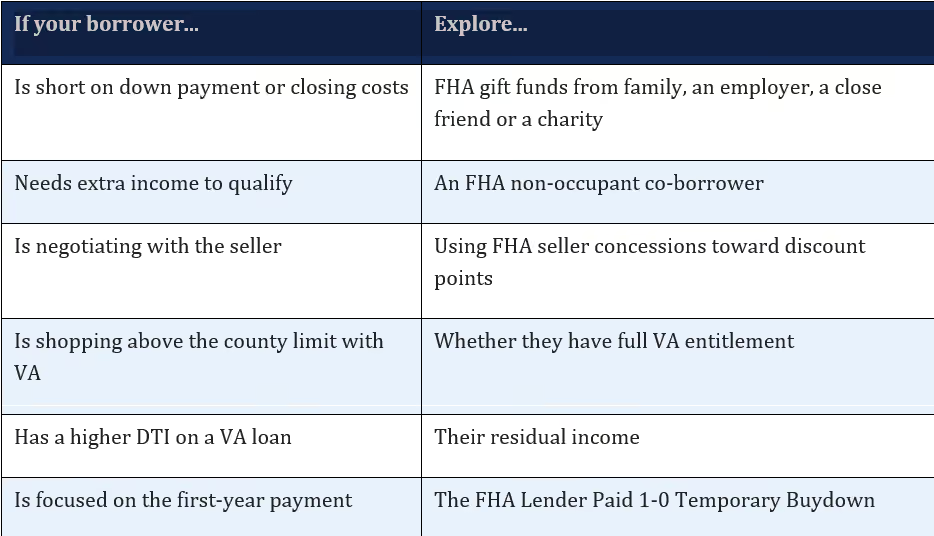
Gift funds can cover the down payment and closing costs.
On an FHA loan, the money to get home doesn't have to come entirely from the borrower. FHA allows gift funds from a range of acceptable donors, including:
• Family members
• An employer or labor union
• A close friend with a clearly defined and documented relationship with the borrower
• A charitable organization
• A governmental agency or public entity with a homeownership assistance program
An eligible gift can cover the borrower's entire minimum required investment and eligible closing costs. The key is documentation: a gift letter, the donor's relationship to the borrower, and a clear paper trail showing the transfer of funds. The donor can't be an interested party to the transaction, such as the seller, builder or real estate agent.
The conversation to have: If a borrower says they don't have enough saved, ask who in their life might want to help. The answer may be broader than they think.
Non-occupant co-borrowers can help a borrower qualify.
Buying a home doesn't always have to be a solo effort. FHA allows a non-occupant co-borrower, someone who won't live in the home, to add their income and credit to the application. This can be especially helpful for first-time homebuyers who have steady income but need a little extra support to qualify.
The relationship matters. When the non-occupant co-borrower is a family member, financing can go up to the standard FHA maximum on a one-unit property. When the co-borrower isn't related, the maximum loan-to-value is lower. Your Account Executive can walk through how the relationship affects your specific scenario.
The conversation to have: Ask whether a parent, sibling or other family member is willing to be on the loan. It can change what's possible.
Seller concessions can do more than cover closing costs.
FHA allows interested-party contributions of up to 6% of the sales price. Those funds can go toward eligible closing costs, prepaid items and discount points. That last piece is where the conversation gets interesting.
In a market where buyers have more room to negotiate, a seller concession can be used to buy down the borrower's rate. Instead of only reducing cash to close, the concession can help shape the monthly payment for the life of the loan. Seller contributions can't be used toward the borrower's minimum required investment, and contributions above 6% reduce the sales price for underwriting.
The conversation to have: When your borrower and their agent are negotiating, talk about how a concession could be structured. Cash to close and the monthly payment are both on the table.
VA: Look at the Whole Financial Picture
Full entitlement means no VA county loan limit.
Veterans with full entitlement are not subject to VA county loan limits. If your borrower has never used their VA benefit, or has used it and had their entitlement fully restored, VA's guaranty isn't capped by the county limit. That opens the door to higher-priced homes without a down payment requirement from VA.
The loan still has to make sense. The borrower must qualify based on credit, income, assets and the property's value, and lender guidelines still apply. Veterans with remaining, rather than full, entitlement follow a different calculation that may involve a down payment.
The conversation to have: Don't assume a VA borrower is limited by the county limit. Check their entitlement status first.
Residual income tells more of the story than DTI.
VA underwriting looks closely at residual income: the money a household has left each month after paying major expenses and obligations. VA sets residual income guidelines based on household size, loan amount and region of the country.
This matters because a DTI ratio is only one number. A borrower with a higher DTI may still have strong residual income, and VA treats that as an important part of the credit decision. When DTI runs above 41%, residual income becomes even more central to the file.
The conversation to have: Before you pass on a VA scenario because of DTI, look at what's left at the end of the month. Then bring it to your Account Executive.
A Little Payment Relief in Year One
Payment is often the final question a borrower asks. To help with that conversation, PwrTPO now offers the FHA Lender Paid 1-0 Temporary Buydown.
With a 1-0 buydown, the borrower's rate is reduced for the first year of the loan, then returns to the note rate for the remaining term. Because it's lender paid, the borrower and seller don't have to fund it. That first-year breathing room can help borrowers settle into homeownership, furnish a new home or manage moving costs.
Paired with competitive government pricing, it's one more reason to take a second look at FHA for your borrowers. Ask your Account Executive about current pricing and eligibility.
Quick Reference: Questions to Ask Before You Rule It Out
The Right Solution Starts With the Right Conversation
At PwrTPO, we believe the best loans start with better questions. Our Account Executives and underwriters work through scenarios with you, not just quote guidelines back to you.
Our underwriters average 15+ years of experience, every underwriting decision is made by a person, and our operations are 100% U.S.-based. The result is an average of about 14 days from submission to clear to close.
Have an FHA or VA scenario you almost ruled out? Bring it to your PwrTPO Account Executive. Let's talk about it.
Equal Housing Lender | NMLS ID #1124061. This content is intended for mortgage professionals only and is not a commitment to lend. Program guidelines, pricing and eligibility are subject to change.