
Four Agencies, Four Paths: How PwrTPO Finds the Way to Close Your Condo Deal


In August, we covered the Fannie Mae and Freddie Mac condo guideline updates and PwrTPO's decision to adopt them ahead of the required timeline. If you missed it, you can catch up here: The Condo Market Just Changed. Here Is What Your Borrowers Need to Know.
Those changes are now fully in effect. Limited Review is gone, the $50,000 cap on per-unit master policy deductibles is in place, and Fannie Mae's 15% reserve minimum arrives on January 4, 2027. More condo projects are getting flagged than a year ago, and more mortgage professionals are asking the same question: if this building will not clear, what are my options?
Here is the answer we give our partners. A condo that does not clear one agency's review often clears another's. PwrTPO underwrites condo files against all four major playbooks: Fannie Mae, Freddie Mac, FHA, and VA. Bring us the HOA documents, and our Condo Team will tell you quickly which path gets your borrower to the closing table.
Fannie Mae: A Wider Fast Lane for Small Buildings
With Limited Review retired, Fannie Mae's Waiver of Project Review is the main fast lane left, and it now covers projects of up to 10 units, up from 4. It applies to new and established projects that are not part of a master association, are not flagged "Unavailable" in Condo Project Manager, and carry the required insurance. For small buildings, that is a real shortcut.
Fannie Mae has also removed the investor concentration cap for established projects, which means buildings that used to be flagged for too many non-owner-occupied units may be back in play. And new construction condo projects in Florida no longer require a mandatory PERS review, which removes a barrier that used to sideline new Florida developments.
Before you assume a lost deal: ask us to run a small building through Fannie Mae's waiver path.
Freddie Mac: The Underused Shortcut
Freddie Mac offers four review pathways: Established, New, Exempt from Review (for 2 to 4 unit projects, or 5 to 10 units without a master association), and Reciprocal Review. That last one is the most overlooked. Reciprocal Review accepts a project's existing approval instead of re-underwriting it from scratch, which can make it the fastest of the four agency paths.
Keep in mind that Freddie Mac caps single-entity ownership at 10% of units regardless of project size, so a small building that works for Fannie Mae may not work for Freddie Mac, and the reverse can also be true. That is exactly why reviewing against more than one playbook matters.
Already approved elsewhere? Ask whether Reciprocal Review can skip the re-review.
FHA: Single-Unit Approval Keeps Deals Alive
FHA approves projects through two routes. Under HRAP, the HOA, the developer, or a lender without delegated authority submits the project to HUD for review and approval. Under DELRAP, a lender with delegated authority reviews and approves the project directly, without waiting in the HUD queue. PwrTPO has delegated authority, so our Condo Team can use DELRAP for full project reviews and keep your file moving.
The real selling point is Single-Unit Approval (SUA). A unit can qualify for FHA financing even when the building was never FHA approved, as long as the project meets SUA eligibility requirements for size, completion, occupancy, and ownership concentration. As conventional guidelines tighten, SUA becomes one of the most valuable tools available. Once the condo questionnaire is received, our Condo Team gets to work submitting for SUA approval through FHA Connection (FHAC). With improved efficiencies at FHA, approval can be completed in as little as 24 to 48 hours, and once the condo is approved, FHA allows the FHA case number to be issued.
One more tip: FHA-approved projects must recertify every three years. Before you rely on a building's approval, confirm it has not quietly lapsed.
Not on the FHA-approved list? That does not automatically rule out FHA. Ask us to check it against SUA first.
VA: Start Early
VA works differently. There is no single-unit approval path, so the entire project must be VA approved before any unit in it can close. You can check a project's status on the VA's Loan Guaranty site, where approved projects are listed by status.
VA also has a few project provisions that can lead to rejection unless the HOA amends its documents, including a right of first refusal, a super-lien clause that puts HOA liens ahead of the mortgage, and percentage-based transfer fees. If a project is not already approved, the approval process takes time, so the earlier the HOA document request goes out, the better.
No VA approval on file? That is not a no. It is a reason to start now.
The Four Paths at a Glance
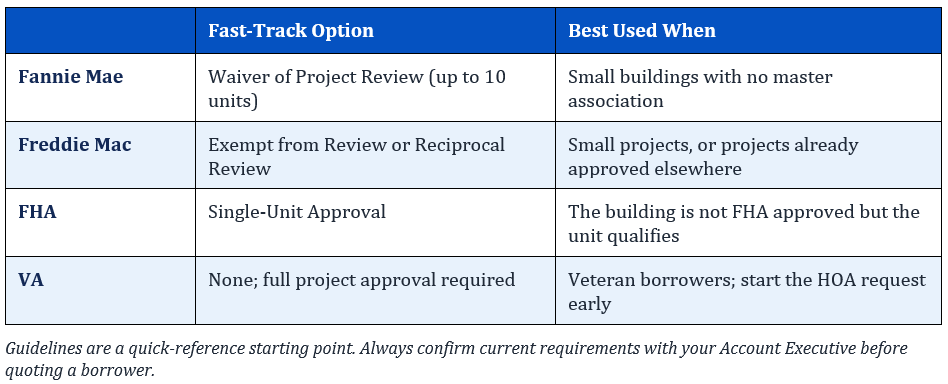
Know What Does Not Fit Agency Guidelines
Some properties will not clear any of the four agencies, and knowing that early saves everyone time.
Condotels and short-term rental buildings. Projects that operate like a hotel, with rentals under 30 days, a mandatory rental pool, or hotel-style services, are ineligible for Fannie Mae, Freddie Mac, FHA, and VA financing. Rather than pushing these through agency review, bring them to us to see whether PwrTPO Prime Plus is a fit.
New construction. Presale thresholds apply. Fannie Mae and Freddie Mac generally require 50% of units sold or under contract, VA sets a higher bar for unconditional approval, and FHA applies its own test that can vary by phase. Confirm project by project.
Co-ops. A co-op is not a condo. The collateral is stock in a housing corporation plus a proprietary lease rather than real property, and the rules are different. If your borrower's building is a co-op, ask early whether it is a fit.
Condo Deal Hit a Wall on Agency? Don't Walk Away From It.
Condo guidelines on agency loans have changed, and more buyers are finding out their building doesn't make the cut. The borrower is solid. Now what?
That's exactly where PwrTPO Prime Plus comes in. We finance non-warrantable condos up to 80% LTV on primary residences, second homes, and investment properties, with loan amounts up to $3.5 million.
Plus, your borrower has five ways to qualify:
• Full Documentation
• Streamline Documentation
• Asset Depletion/Asset Qualifier
• 12 Month P&L
• 12 or 24 months of personal or business bank statements
Reach out to your PwrTPO Account Executive to talk through your next condo deal.
Submit It Right: The Insurance Piece
Whichever path a file takes, insurance coverage is reviewed on every condo loan, and it remains one of the most common reasons condo files pick up conditions. Our Condo Team created a one-page resource to help: the Condo Insurance Quick Guide.
It covers everything to collect before you submit, what the master policy needs to show, the full list of required perils, and a simple decision flow for whether your borrower needs an HO6 policy. It also covers the most common insurance conditions we see, including a policy expiring within 30 days, missing replacement cost language, deductibles outside guidelines, a missing Crime/Fidelity Bond or Equipment Breakdown coverage, and a missing HO6 when one is required. Every one of those can be caught before submission.
A few quick facts worth remembering: ACV for roofs is acceptable, Inflation Guard is not required, per-unit deductibles cannot exceed $50,000, and per-occurrence deductibles cannot exceed 5% of the building coverage.
The Bottom Line
The 2026 updates have made condo financing more demanding, but a flagged project is not the end of the conversation. With four agency playbooks, Prime Plus for non-warrantable condos, and a dedicated Condo Team with underwriters who bring 15+ years of experience to every file, PwrTPO gives you more ways to get to yes.
Have a condo scenario you are not sure about? Send the HOA documents to your Account Executive. We will tell you which path fits, and we would rather see it early than after an underwriting surprise.
Equal Housing Lender | NMLS ID #1124061
Sources: Fannie Mae Selling Guide; Freddie Mac Single-Family Seller/Servicer Guide; HUD Handbook 4000.1; VA Lenders Handbook; PwrTPO Condo Insurance Quick Guide