
Government & Conventional Lending: Income, Assets & Credit Guideline Clarifications

Underwriting Clarity: What You Need to Know About Income, Assets & Credit This Week
Loan approvals live and die in the details, and this week's topic is all about the fine print that can make or break a file. From how variable-hour income gets classified to how Buy Now, Pay Later loans are treated across Fannie Mae, Freddie Mac, FHA, and VA, here's what you need to have top of mind as you package and submit loans this month.
Fixed vs. Variable Income: The Guaranteed Hours Question
Say you have a borrower who is paid an hourly rate but works variable hours, and the employer verifies a minimum guaranteed number of hours per pay period. Is that income fixed or variable?
If the borrower is paid a fixed hourly rate and qualifies using only the minimum guaranteed hours, and documentation supports that amount consistently, Fannie Mae allows the lender to treat that income as fixed. The moment you need to reach beyond the guaranteed minimum to qualify, though, the income above that floor must be documented and averaged under standard variable income requirements.
Pull the employer's guaranteed-hours language early. It can determine whether you're building a file around fixed income or a 24-month variable income average.
Can a Pay Raise Count as Qualifying Income?
Yes, under specific conditions. A future pay increase from a borrower's current employer can be included as qualifying income when all of the following are true:
● The income is fixed base pay only, with no variable components.
● The transaction is a purchase or limited cash-out refinance.
● The increase takes effect no later than 60 days after the note date.
● The increase is fully verified directly by the employer using Form 1005 or equivalent documentation spelling out the terms.
● The borrower is not employed by a family member or other interested party to the transaction.
This is a great tool when your borrower has a documented raise already in motion, but every box has to be checked. Partial documentation won't fly.
Using Business Assets to Qualify
Business assets can absolutely fund a down payment, closing costs, or reserves, as long as the borrower is a verified owner on the account and the funds are documented per standard verification of deposit requirements.
Where it gets more involved is when the borrower is also using self-employment income from that same business to qualify. In that case, the lender must perform a business cash flow analysis before pulling funds. The goal is simple: make sure withdrawing money for this transaction doesn't destabilize the business the borrower depends on for income. Expect requests for additional business bank statements or a current balance sheet to support that analysis. We require 3 of months bank statements for the lender cash flow analysis.
What Actually Counts as Liquid Reserves?
Reserves are measured in months of the qualifying PITIA payment that a borrower could cover using liquid or near-liquid assets after closing. Acceptable sources include:
● Checking and savings accounts
● Stocks, bonds, mutual funds, CDs, money market funds, and trust accounts
● The vested amount in a retirement savings account
● Cash value of a vested life insurance policy
What doesn't count: unvested funds, funds only accessible upon retirement, termination, or death, stock in an unlisted corporation, non-vested stock options or restricted stock, personal unsecured loans, and rent-back credit. And remember, funds to close come out of available assets before reserves are calculated, so don't double-count the same dollars.
Buy Now, Pay Later Loans: How the Agencies Compare
BNPL obligations are showing up on more credit reports, and every agency treats them a little differently. Here's the side-by-side your processing team will want bookmarked:
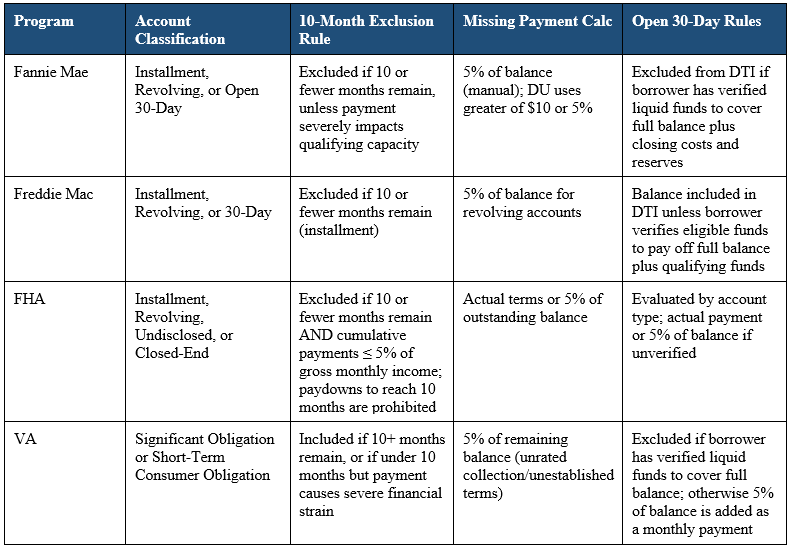
Your biggest takeaway: verified liquid funds to pay off a BNPL balance in full can exclude it from DTI under Fannie Mae, Freddie Mac, and VA guidelines. FHA does not offer that same payoff exclusion and prohibits paying down a balance simply to get under the 10-month threshold. Know which investor you're targeting before you assume a BNPL balance won't count against your borrower.
Questions on how any of this applies to a file you're structuring? Your PwrTPO Account Executive is ready to help, reach out any time.